CA Licensed PLS #8099 | Calabasas, CA

June 6, 2026
If you are involved in a commercial real estate transaction, a land acquisition, or a title insurance matter, there is a good chance your next land title survey will need to comply with the 2026 ALTA/NSPS Land Title Survey Standards. These standards took effect February 23, 2026, replacing the 2021 edition that had governed the industry for the previous five years.
For surveyors, title companies, real estate attorneys, lenders, and developers, the 2026 update is not a wholesale rewrite - but it does introduce meaningful changes, particularly in Table A and in how surveyors must document and communicate findings. Understanding these changes matters for anyone who orders, reviews, or relies on an ALTA/NSPS Land Title Survey.
This article explains what the 2026 ALTA/NSPS Standards are, what changed from 2021, why Table A items matter, and what these revisions mean in practice.
The ALTA/NSPS Land Title Survey Standards are a nationally uniform set of minimum requirements jointly published by the American Land Title Association (ALTA) and the National Society of Professional Surveyors (NSPS). They govern how licensed surveyors must conduct, document, and certify a specific type of commercial real estate survey known as an ALTA/NSPS Land Title Survey - sometimes called simply an ALTA survey.
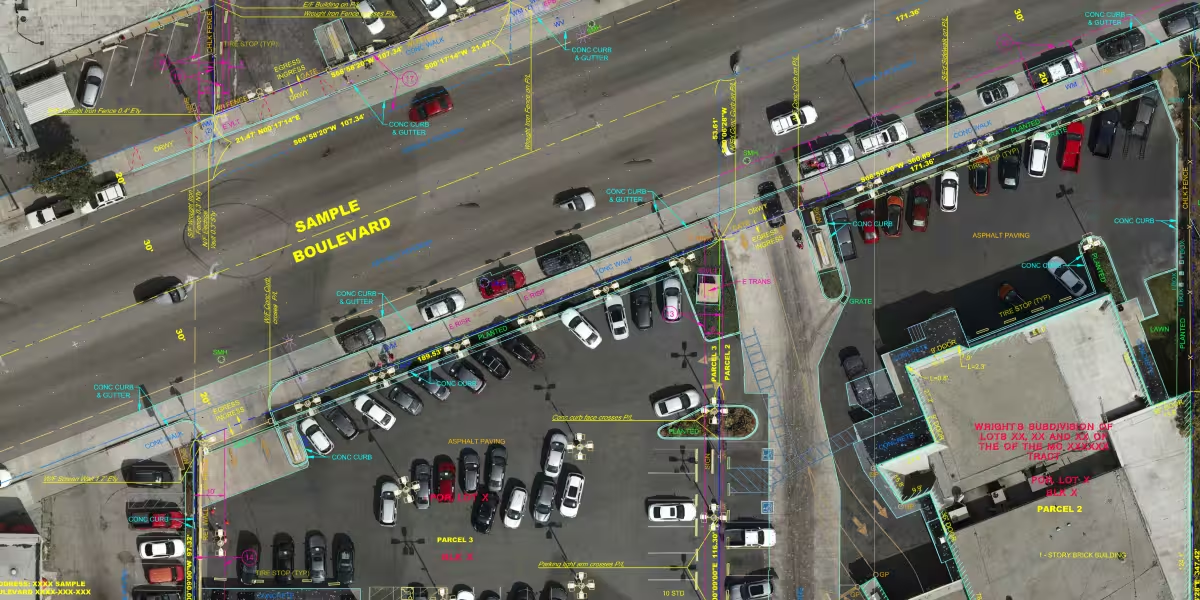
Unlike a basic boundary survey, an ALTA/NSPS Land Title Survey is designed to satisfy the requirements of title insurance companies, lenders, and sophisticated buyers in commercial and institutional real estate transactions. The survey must address boundary location, improvements, easements, rights of way, utilities, access, encroachments, and other conditions that could affect title or the use of a property.
A complete ALTA/NSPS Land Title Survey consists of four components:
The standards set minimum performance requirements. They do not replace applicable state law or local survey regulations. Where the ALTA/NSPS standards and a jurisdictional requirement conflict, the more stringent standard applies.
The 2026 edition retains the same overall structure as the 2021 standards - eight numbered sections followed by Table A. Most of the core fieldwork and plat requirements are carried forward with clarifications and minor editorial changes. The most significant practical changes involve Table A, which was reorganized and expanded, and the addition of a new mandatory encroachment summary item.
The following is a section-by-section summary of the notable changes.
The 2021 standards described the fieldwork component as "on-site fieldwork." The 2026 edition simply says "the fieldwork," dropping the phrase "on-site." This change is consistent with the revised Table A Item 15, which more broadly addresses the use of imagery and non-ground-based data collection methods. The word "2021" was also removed from the phrase "A complete 2021 ALTA/NSPS Land Title Survey includes," making the language version-neutral.
The surveyor's request language was updated to require that the client specify a "2026 ALTA/NSPS LAND TITLE SURVEY" (previously "2021"). This is a routine version-year update that changes with each edition.
The definition of Relative Positional Precision was refined for technical clarity. The 2021 version defined it as the length of the semi-major axis of the error ellipse representing the uncertainty in the position of a monument or witness marking any boundary corner relative to the position of an adjacent monument or witness. The 2026 version reframes the definition as the error ellipse of the line connecting adjacent monuments or witnesses marking boundary corners. The practical meaning and the allowable tolerance - 2 cm (0.07 feet) plus 50 parts per million - remain unchanged.
The 2026 version also removes the phrase "or approximately 2 standard deviations" from the description of the 95 percent confidence level, simplifying and clarifying the language without changing the standard.
The 2021 edition included a requirement that the surveyor be provided with current record descriptions of any adjoining properties ("adjoiners"), except where those adjoining properties were lots in a platted, recorded subdivision. The 2026 edition removes this as a standard document requirement. The adjoiner description requirement, which was sometimes impractical to fulfill in densely developed areas, is no longer listed among the documents the surveyor must receive.
Additionally, the 2021 language stated the surveyor "will" be provided with appropriate data; the 2026 version uses the stronger term "must," reinforcing that proper document delivery is a prerequisite for survey performance.
The 2021 standards stated the survey must be performed "on the ground" (except as otherwise negotiated under Table A Item 15). The 2026 edition replaces this with the more general requirement that fieldwork must be performed "using practices generally recognized as acceptable by the surveying profession." This change better accommodates modern data collection methods, including aerial mapping, mobile LiDAR, and other remote sensing technologies, without requiring a specific Table A negotiation for every non-traditional methodology.
In Section 5.B.iii, the phrase "Visible evidence" of physical access was changed to "Evidence," removing the modifier. This is a minor but meaningful clarification - physical access conditions are to be reported based on evidence observed in the fieldwork, whether or not they are visually obvious.
In Sections 5.C.i and 5.E.iv, the word "adjoiners" was updated to "adjoining properties," standardizing the terminology used throughout the document.
Section 6.C.vi updated the reference for adjoining non-platted properties from "non-platted adjoining land" to "non-platted adjoining properties," and similarly updated references to "public records" to "tax records." These are terminology standardizations.
Section 6.C.viii updated the insurer release language. The 2021 version referred to the insurer providing "evidence of a release of" an easement; the 2026 version says "evidence that the easement has been terminated or extinguished" - more precise language that describes the actual legal conditions under which an easement ceases to burden a property.
Section 6.D.ii.(g) was updated to reflect the renumbering of Table A items. The reference now reads "21(a), 21(b), 21(c)" for custom items (previously "20(a), 20(b)"), consistent with the expansion of the standard Table A items from 19 to 20.
Section 6.D.ii.(l) is new to the 2026 edition. It adds a required plat notation: "Notation of any parol statements by interested landowners or occupants as to title or boundary issues relating to the surveyed property." This is a new mandatory disclosure requirement - if any person with an interest in the property makes oral statements to the surveyor regarding title or boundary during fieldwork, those statements must be noted on the face of the plat or map.
Section 6.D.iii was updated to change "state statutes" to "state statute" and "local ordinances" to "local ordinance" - grammatical corrections with no substantive effect.
The 2021 version stated that if the surveyor is required to record or file a plat, it "shall" be so recorded. The 2026 edition replaces "shall" with "must," consistent with a broader editorial shift throughout the document toward more unambiguous mandatory language.
Table A is the section of the ALTA/NSPS standards that allows clients to customize the scope of an ALTA survey beyond the minimum requirements. Understanding Table A is critical for anyone ordering or reviewing an ALTA survey, because selected items directly affect survey cost, survey scope, fieldwork complexity, and the information shown on the plat.
The ALTA/NSPS standards establish a baseline of what every ALTA survey must include: boundary location and closure, rights of way and access, visible improvements, evidence of easements and servitudes, utilities visible on or above the surface, and other features enumerated in Sections 5 and 6. These are not optional - they are the floor.
Table A items go beyond that floor. They are optional items negotiated between the surveyor and client. When a Table A item is selected and checked, the surveyor becomes responsible for performing and documenting the work described by that item. The fee for selected items is negotiated separately from the base survey fee.
The 2021 Table A contained 19 numbered items, with a blank Item 20 for custom additions negotiated between the surveyor and client. The 2026 Table A expands to 20 standard items, with the blank custom item slot moving to Item 21. Items 1 through 19 are carried forward from 2021, with the notable modifications. Item 20 is entirely new and substantive.
Item 15 underwent significant revision. In 2021, it addressed a broad range of technologies - "rectified orthophotography, photogrammetric mapping, remote sensing, airborne/mobile laser scanning and other similar products, tools or technologies" - as methods for showing the location of certain non-boundary features where ground measurements were not required.
The 2026 version narrows and reorganizes this item. The broad technology list is replaced with the simpler term "imagery," and the item now explicitly applies to features other than the boundary survey portion and features in close proximity to a boundary or relevant setback line. Most importantly, the 2026 version adds a new requirement not found in 2021: the surveyor must agree with the client in writing on the specific imagery to be used, including its source, date and/or version, and any applicable licensing costs and requirements.
This change reflects the increasing use of commercial aerial and satellite imagery in survey practice and adds a layer of transparency and client consent that was absent before.
Item 11(b) was revised to clarify that a private utility locate request may be coordinated by either the surveyor or the client. The 2021 version referred only to markings coordinated by the surveyor. This is a practical acknowledgment that in many transactions, the client or their contractor arranges the utility locate independently, and the surveyor incorporates the resulting information into the survey.
This is the most substantive new addition to the 2026 standards. When Item 20 is selected, the surveyor must prepare a tabular summary of identified encroachments and site conditions, placed on the face of the plat or map. The table must identify physical conditions observed during fieldwork or identified during plat preparation, and provide a means for a reviewer to locate those conditions on the plat.
The conditions required to be summarized include:
The standard explicitly states that this table does not express a legal opinion as to ownership or the nature of any encroachment, and that it may not be a comprehensive list of all concerns shown on the plat. Its purpose is to create a structured, scannable reference tool - a checklist of potential title and encroachment issues - for reviewers including title officers, attorneys, and lenders.
Item 20 is optional and negotiated. However, for complex commercial properties - multi-tenant buildings, properties with shared walls, projects with tight setbacks, or sites where encroachment issues are suspected - selecting Item 20 adds significant value to the survey deliverable.
Any ALTA/NSPS Land Title Survey commencing on or after February 23, 2026 must comply with the 2026 standards. The certification language on the plat or map must reference the 2026 Minimum Standard Detail Requirements. Using a 2021 certification on a new survey would be technically non-compliant.
Surveyors should update their standard scope of work templates, proposal language, and Table A checklists to reflect the 2026 numbering. The addition of Item 20 as a new encroachment summary option provides an opportunity to offer a higher-value deliverable to clients, particularly for urban infill projects, multi-parcel assemblages, and properties with complex boundary histories.
The removal of the adjoiner description requirement from Section 4 reduces one administrative burden, particularly in jurisdictions where obtaining current legal descriptions for all adjacent parcels was time-consuming.
Surveyors should also note the new requirement in Section 6.D.ii.(l) to document any parol statements made by landowners or occupants regarding title or boundary issues. This is a fieldwork and documentation habit that must be formalized - conversations with property owners that touch on boundary or title should be noted and disclosed on the plat.
Title officers and attorneys reviewing ALTA surveys should confirm that surveys ordered on or after February 23, 2026 bear the 2026 certification. A survey certified to the 2021 standards is not necessarily deficient if the survey was contracted and performed before the effective date, but any new survey should reflect the current version.
The new Item 20 encroachment summary table, when selected, creates a more readily accessible summary of potential issues for title review. This can streamline the process of identifying survey exceptions and evaluating the scope of coverage to be provided.
The updated easement release language in Section 6.C.viii - requiring evidence that an easement "has been terminated or extinguished" rather than merely evidence of a "release" - aligns more precisely with title insurance underwriting standards and the legal conditions under which an easement actually ceases to burden a property.
Developers and design professionals who rely on ALTA surveys for due diligence and site planning should be aware that the 2026 standards afford more flexibility in how non-boundary features are captured. The updated Item 15 allows for imagery-based data collection for features away from the boundary, subject to a written agreement on imagery source and licensing. On large or complex sites, this can reduce cost and accelerate delivery of survey data for use in site planning and design.
The new encroachment summary table (Item 20) is particularly valuable early in due diligence. Selecting this item can surface boundary, setback, and access issues in a structured format before design work begins - potentially avoiding costly surprises later in entitlement or construction.
Property owners and their lenders who routinely order ALTA surveys in connection with acquisitions or refinancing should ensure their survey order letters and title company requirements reference the 2026 standards. Most lenders require ALTA surveys to comply with the current standards as a condition of underwriting.
The practical scope of the survey - what is measured, what is shown on the plat, and what optional items are selected - determines the cost and the utility of the survey. Selecting the right Table A items for a given transaction is a conversation worth having with your surveyor before the survey is ordered.
The 2026 ALTA/NSPS Land Title Survey Standards represent a focused update to an already mature and well-structured set of requirements. The core structure, measurement standards, fieldwork requirements, and plat content rules are substantially preserved from 2021. The most meaningful changes are:
For commercial real estate professionals in Southern California and across the country, the message is straightforward: any ALTA survey ordered now should reference and comply with the 2026 ALTA/NSPS Land Title Survey Standards. If you have questions about scope, Table A item selection, or how these standards apply to a specific property, consult with a licensed professional land surveyor experienced in ALTA survey work.